Thursday, 30 November 2017

Darwin


Australia is divided into six states and two territories, each of which has its own capital city and parliament.

The states and their capital cities are:
  • Victoria - Melbourne;  
  • Tasmania (our island state) - Hobart;
  • South Australia - Adelaide;
  • Western Australia - Perth;
  • Queensland - Brisbane; and
  • New South Wales - Sydney. 

The territories and their capital cities are: 
  • the Northern Territory - Darwin; and 
  • the Australian Capital Territory (which is like an island in rural New South Wales) - Canberra (our national capital).

The territories only have small populations, even though the Northern Territory occupies a large area of land. This is because most of the Northern Territory is remote, with very rugged terrain that is very hot and dry in the Dry Season and subject to severe flooding in the Wet Season. This is part of our Australian ‘Outback’. However, there are regions in which there are vast cattle stations, which have to be vast because the grasses are so sparse and can support very few cattle per hectare, and regions where there is some agriculture, including growing mangos.  

I caught the Ghan from Adelaide, in the south, to Darwin in the north. I only had a short time to spend in Darwin before catching my ship for a ten-day cruise along the Kimberley coast, the most stunning, fascinating land I have ever seen. I will start to show you that in my next post. 

Darwin, which is built along the shores of a natural harbour, is our gateway in the north. What first struck me about Darwin was how new all the buildings were, many of them high rise and very modern. This is because the entire city was flattened in 1974 by the tropical cyclone ‘Cyclone Tracy’ and had to be rebuilt, this time with cyclone-proof buildings. The link to the original newsreel of that cyclone is given below. On one of my later visits to Darwin, I went to a museum where they had a room in which you could hear a sound recording of the cyclone. It was just so loud and terrifying! 


Anyhow, whilst I was in Darwin on that occasion, I went on a tour visiting significant World War 2 sites.  For those of you who don't know, Darwin and right along our northern coastline were heavily bombed by the Japanese. It is only thanks to our American allies that we were eventually saved.  First we visited the Charles Darwin National Park, where we saw old World War 2 weapons bunkers, that would have been well camouflaged by all the trees - and learned what it is to be ‘eaten alive’ by small microscopic insects that proliferate in some parts of this region. (The nasty little ‘beasts even took themselves below my neckline, so I ended up with little blisters over much of my body, despite having put on tropical insect repellant.)  

We saw some war memorials along the coastline then went on a small boat on the Darwin Harbour across to the Darwin Military Museum, where we had an incredible interactive, multimedia experience. There I learned so much of what had actually occurred, which none of the Australian public knew until fifty years after the war ended. I was deeply shocked! This was all the more meaningful to me because when I was born my father was away with his hospital unit in the Australian Army heading to the islands around New Guinea where we were fighting the Japanese.

Some of you may have seen the 2008 Baz Luhrmann movie starring Nicole Kidman and Hugh Jackman - ’Australia’ - in which there are graphic scenes of the bombing of Darwin, as well as some great scenes of some of the remote regions of the Northern Territory. 

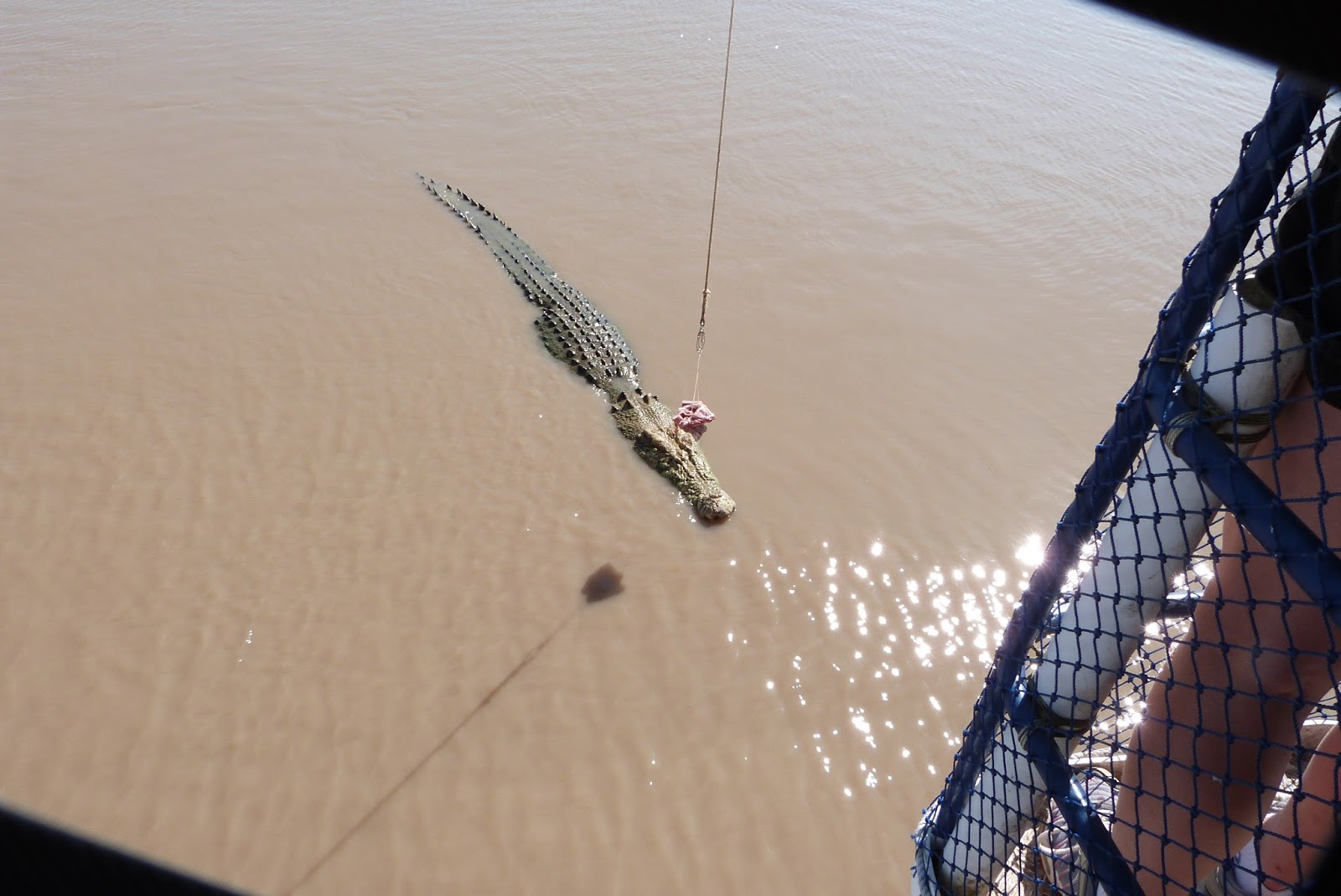
As well, I went on a tour to see ‘Jumping Crocodiles’ at the Adelaide River and nearby wetlands, which are along the way towards the famous Kakadu National Park. The water in the river was very milky, so until the boat operators dangled some raw meat above the water, you would never have known the river was full of crocodiles. But goodness, they were so fast I could not get a photo of one leaping in the air. But it made me realise how careful you have to be on and near rivers up in this region. 

The following photos give you a small glimpse of some of the things I saw on this first visit to Darwin. 

Darwin and Darwin Harbour from my hotel balcony.

Coming down to our boat along the Adelaide River. 

This crocodile only came to the surface when the meat was dangled. You can tell from the shadow that the meat was hanging about three metres above the water. 


The crocodile leaped and then fought like mad in the water to pull the meat off the rope.  

Model of a crocodile at this tourist spot. 

Part of the nearby wetlands. We had to remain in our small coach because there were crocodiles lurking in the water. 


Entering the Charles Darwin National Park.

Inside one of the bunkers where weapons had been hidden.


Cruising across Darwin Harbour. At that time there were at least 1000 crocodiles swimming about the harbour. On top of the cliffs here big cannons had been placed to ward off a possible Japanese attack, but it was expected they would arrive by sea. So the cannons were unable to defend Darwin. The Japanese war planes were over them before the the soldiers could change the angle at which the cannons were set. 

Part of the outdoors display at the War Museum. 


Tuesday, 28 November 2017

Katherine Gorge

After Alice Springs, we all boarded the Ghan again. The next day, we had another stop, this time at the picturesque Katherine Gorge. 

Katherine Gorge is actually a series of gorges, which are located a couple of hours journey by road from the railway line. It must look spectacular from the air. In fact, many of the passengers elected to pay the extra to fly over the gorge rather than cruise along it, as we did. 

Nevertheless, the cruise was very worthwhile. I chose to cruise in three of the gorges; some chose to just cruise around the first gorge. To go to the second gorge you had to climb over rocky ground between the two gorges in the heat, and board a second boat. But the views were well worth the effort. And that was far less effort than the people who were hiking along the clifftops and those rowing canoes through the gorges were making. 

My photos can barely do justice to the rich colours of the very old rocks, the height of the cliffs, and the green vegetation. The stark contrast between light and shade at that time of day made it more difficult to capture some of the sights, but they were fascinating to see. Along the way there were sandy shores with signs warning you not to climb up them, because some were used by crocodiles to lay and bury their eggs. These were mostly freshwater crocodiles, which do not grow as large as saltwater crocodiles and are not as deadly.  That is not to say a saltwater crocodile could never be found there, because floods in the Wet Season can open up new accessible routes to them. In the third gorge, we saw people swimming in the lagoon. The Aboriginal man who was manning our boat, and had a great sense of humour, said “You know what we call those people?” . . . “Meat!” . . . 

That trip was my first sighting of crocodiles on my journey. Crocodiles are now a protected species in Australia, on the grounds they make an essential contribution to the river ecosystems, so there are thousands of them up north, not only in river systems but also in bays. Aboriginal people, however, are allowed to kill a limited number for their food. And some eggs can be harvested for the crocodile farm in Darwin - at great risk I would add. 

After we returned to the jetty at the first gorge, we went to a cafe for an afternoon tea. This whole park is owned and managed by Aboriginal people. The cafe had interesting architecture, rather like a boomerang if I recall correctly. There we had little dainty nibbles such as sausage rolls for us to try meat from emus and crocodiles. They were really tasty! If you did not know where the meat came from, you would have thought it was chicken or pork. 

Anyhow, I can highly recommend a trip to Katherine Gorge. On one trip I did there, we had a magnificent dinner on a boat at sunset.  It was a wonderful experience! I will talk more about that on a later occasion. 


On board our boat.

In the first gorge.

These were very old rocks. 

You can just make out the sandy parts of the shore where crocodiles could lay their eggs. 

Moving to the second gorge.

Along the walk to the second gorge. There were some great reflections in the water.

If I recall correctly, I took this photo in the third gorge where we saw people swimming. 

In the cafe.


Friday, 24 November 2017

A remarkable lady, and my first visit to Alice Springs

Goodness, time has flown since I wrote my last post! And Christmas Day is just one month away today! I have been absolutely flat out, as you may expect, still catching up with different friends and doing so many necessary tasks. Of course for eight months I was spared from cooking, housework, ironing, laundering the household linen, watering the garden, and so forth, so I really cannot complain. In fact I have rather enjoyed taking all these responsibilities up again. 

I promised to tell you a story about a lady I met on the Ghan, and to introduce you to Alice Springs.

I am changing the details about the lady a tad, as I do not know her name or how to contact her to ask her permission to tell her story. So often you are ‘ships in the night’ with fellow passengers on any form of transport, but especially on trains when you are thrown together for just a couple of days. And yet  some people can make an enormous impression on you that stays with you forever. Such was the case with this lady. I shall call her Anne. She was just a few years younger than me, I would think, and very dignified and self-possessed.

Anne and I began to chat over a meal, but moved to the lounge car and continued our conversation for quite a while. Anne began to tell me her story when we are talking about what we had done in our earlier lives and I mentioned I had been a teacher.  She told me that when she was only about ten years old, one of her teachers had told her she ‘would never amount to anything’ because she was always late to school. What a dreadful thing to say to a child! Did the teacher not investigate why she was late?

The reason why she was late was because her mother was running a nursing home but had been enticed by some colleagues into going for a drink after work with them when she was having a struggle with doing both that and looking after her children on her own. (Her alcoholic husband had abandoned them some time ago.) There were still five children at home, the oldest girl being Anne. Very soon Anne’s mother became an alcoholic as well, so of her own initiative Anne took command, not only doing the housework and cooking for her family but also cooking for the residents of the nursing home. She made countless breakfasts and packed lunches before she left for school!  This continued for some years. When she was in her mid-teens she trained as a chef and eventually set up her own catering business, which was so successful she provided employment for many young people. She was really proud of the fact that she involved them in all the decision-making for the business and gave them opportunities to use their initiative and to be creative. I asked Anne how she felt about her mother. She said she felt sorry for her, even then, as a child. 

What an incredible, inspiring woman! I encouraged her to write a book about her life.  But Gee! I wish her unkind teacher could read it! 

In this post I am only talking about my very first visit to the town of Alice Springs in central Australia. This was an official 4-hour tour run by the Ghan. While it was fairly short, it was most memorable, because we visited several significant sites. 

First we went to the headquarters of the Royal Flying Doctor Service, an amazing organisation that gives essential medical support to all those who live in remote areas, flying doctors and nurses to their properties or to nearby airstrips in light aircraft to treat them on site or to take them off to hospital. There we saw a movie about the incredible work they do and then were given a wonderful morning tea of scones and jam and cream and tea and coffee.  

After that we visited an old gaol, where compassionate and innovative work had been done rehabilitating the women prisoners, way ahead of its time. The women were taught many skills that they were able to to use when they left, and were allowed to decorate their rooms and make them a personal space. There we also saw a display of the amazing and valuable contribution many pioneer women, both black and white, had made to the outback region and to their local communities - usually unacknowledged and rarely mentioned in history books. 

Next we visited the War Memorial on a hill overlooking the town, and then the early telegraph station. There were saw the almost dry springs that led to the name ‘Alice Springs’, named after the wife of one of the personnel there.

In a later visit I stayed in Alice Springs and explored the MacDonnell Ranges behind it, which you can see in a couple of the photos. They were just stunning. That will be in a much later post. 

Part of the tribute to the pioneer women.

A view of Alice Springs from up the hill where the War Memorial stands.

Another view of Alice Springs.

There were some lovely bushes of broom out in flower. 

The War Memorial.

The old telegraph station. This was the start of the town. 

The original springs that gave the town its name. 


Sunday, 12 November 2017

The Ghan - travelling 'up and down' the length of Australia

I am finally able to make some time to start talking about my adventures exploring the Australian Outback (also known as the Australian Bush). By ‘Outback’ we mean remote regions that are hundreds or even thousands of kilometres from our major cities. Little townships and Aboriginal settlements may be found in these regions, but all are long distances from one another. Here cattle stations and sheep properties are vast, occupying areas of many hundreds of square kilometres, because the feed and water are so sparse. There are some major highways as well as many unmade roads linking these parts.  A station owner might travel a couple of hundred kilometres along a bush track to have a cup of tea or a beer with their nearest neighbour. Telecommunications are patchy; in some areas you can only communicate by satellite phone. Moreover, many people working in this region can only obtain electrical power using solar panels and storage batteries or diesel generators. And many children learn their lessons through the ‘School of the Air’. 

Understandably, most Australians live in our coastal cities. But that is not to say that people living in the Outback live a life of deprivation and hardship. What they miss out on in terms of ‘mod cons’ they make up for by living in a ruggedly beautiful, unique landscape with wonderful rich colours, pure air, and little traffic and noise. But you would not know or appreciate this unless you travelled through this territory by land instead of by jet. That is why I have thoroughly enjoyed the three trips I have made on our famous train known as the Ghan. 

The Ghan is named after the Afghan cameleers who helped our early explorers discover a route through the interior from Adelaide on the south coast to the north coast of Australia. Tragically some of the earliest explorers died making the attempt, which challenge they undertook not only in a spirit of curiosity and discovery but also so that the early settlers could communicate with the rest of the world through a telegraph cable that had been laid under the sea near our north coast.  Otherwise they had to wait months for ships to arrive with their mail.

Today the Ghan travels between Adelaide and Darwin, a journey that takes three or four days depending on what touring you do along the way. It is nearly a kilometre long and pulled by two massive engines. There are different classes of travel. Platinum Class is the most luxurious, of course, followed by two levels of Gold Class. Platinum and Gold Class passengers have access to comfortable lounges, where drinks and nibbles are part of the package, and dine in fine style in dedicated dining cars. The remaining passengers do not have their own cabins and buy food from a kiosk. This is the way to make the journey on a more limited budget.  

The first time I went on the Ghan, which was in 2013 from Adelaide to Darwin and back, I made the mistake of booking a single cabin. Even though it was in Gold Class, you had to share a shower and toilets with all the other passengers in the same carriage (about 21 others).  And once the bed was pulled down and made up by the steward whilst you had your evening meal, the room was so small you had to be a contortionist to get into the bed from the door! Getting something out of your luggage at that late stage was an almost impossible challenge. So when I went on the Ghan from Darwin to Adelaide in 2015, I booked a double cabin, and all was good. Apart from being a much larger cabin, I had my own toilet and shower too, though the shower was a challenge to use, especially as all the time the train was going ‘bumpity bump’ on the tracks. Thus my advice is - if you can afford it, go Platinum! 

In the two years in which I travelled on the Ghan, the train only stopped at Alice Springs and Katherine Gorge. Whilst it took on fresh food and water, refuelled and pumped out the wastes all the passengers went on tours. These tours, which lasted about four hours, were part of the fares for Platinum and Gold passengers, and were just great. I will talk about mine in the next two or three posts. Nowadays you can do a range of interesting side tours as well. 

Some people asked me if I was bored during those journeys, travelling for three days mainly through a dry desert environment, but my answer is - not at all! I found the landscape fascinating, and met some interesting passengers. Sometimes people that are encapsulated with you in a train will tell you things they would not normally talk about. In fact I will tell you the story of one inspiring lady I met in my next post.   


Unfortunately I have very few photos of the Ghan and the landscape we saw, which photos were taken in 2013, but I hope they will give you some idea of what it was like.


Taken at the Alice Springs Station. You can see the reflection of the station in the train windows. 

Moving away from the platform at Alice Springs.

In the lounge car. I have seen photos from a recent article on the Ghan that suggest this has been refurbished since I travelled on the train. 

Taken from my cabin window early one morning just before the Sun rose. The lighter coloured region was a dry river bed. 

A tribute to the Afghan cameleers at the Alice Springs Station.

The Ghan is very, very long! 

Tuesday, 7 November 2017

My welcome home

I am back on Melbourne now, soon to write about my amazing trip on the Ghan to Northern Australia and the Kimberley, the Kimberley Coast, Kakadu and Arnhem Land. 

What a home-coming I had. I came down with a virus at the end of my stay in Lake Macquarie, which triggered bad asthma, so when I set off on the long journey home I was not full of vim and vigour - yet so looking forward to being home. It was an almost three-hour bus trip back to Sydney (maintenance work was being done on the train tracks), an overnight stay at a hotel located right at the foot of the Sydney Harbour Bridge, then an 11-hour train trip to Melbourne, starting at 7.30 am the next morning. 

By the time the train was pulling into Melbourne, I was exhausted yet excited about seeing my daughter after all this time. Unfortunately my grandson was too ill to come, exhibiting flu-like symptoms after being away on a three-day school camp. My daughter texted me to say she was running late. Meanwhile another friend texted me to ask me if I had arrived yet, as it was bucketing down where she lived. I replied that I could just see a most beautiful rainbow from the train. 

Little did I imagine those text messages were all part of a conspiracy between several of my good friends and my daughter, who were all waiting on the platform with a huge banner to welcome me home and wanted me to think I would be arriving with no-one there to greet me as the train pulled in! One friend had flown all the way from Perth to be there - that is a four-hour flight from the west coast of Australia! And there were photos of friends who would have liked to be there but could not get there from their homes in the Northern Territory and north Queensland! I was absolutely stunned to see them all cheering and waving! What a most wonderful, kind gesture! Of course there were lots of hugs, laughter and photos.

I would add that some of them did the same to farewell me eight months ago, sneaking past a friend and I whilst we were having a coffee on the station concourse down on to the cold windy platform really early in the morning.  At the time, other passengers kept looking at me wondering what all the fuss was about. There was no celebrity to be seen, just an ordinary ‘senior’ lady!  No doubt some of the passengers on the Sydney-to-Melbourne train wondered the same. 

How lucky am I to have such beautiful friends, and such a lovely daughter! 

So off we went home and I relished seeing the city lights at night as we drove the 8 km or so to my home. It was so good to see my city with fresh eyes.  

I let us into the house with some trepidation, wondering what I would find. My house had not been occupied for eight months, though my brother very kindly came around every couple of weeks to check it out - but only from the outside. Would it be a ‘Dracula’s Cave’ full of spiders and spider webs as one of my English friends teased me? 

As it turned out, I found maybe about four dead spiders and about 20 dead millipedes coiled up on the carpet. (Once every few years millipedes start coming under the external doors from the garden, then turn up their toes - do millipedes have toes?- to the daisies.) There was very little dust. 

Before I left I had organised house-sitters but they fell through at the last minute. And I had the windows, venetian blinds, carpets and oven professionally cleaned just before I left so the house was ready for them. It turned out that was not a waste. It really paid off because as soon as I vacuumed up the small number of little dead bodies, the house looked pristine. But I had kept my gardener and my lawn-mowing man coming the whole time I was away, my mail redirected, and my monitored extensive security system on. As well, I have security lights with motion sensors right around the outside of the house, and a light going on and off in the house that was permanently wired into the circuitry. So I was very, very lucky to have my house remain in good condition. The only problem was some plants had suffered from insufficient watering, but they will come back.

At least, I thought that was the only problem. When I went to try on my kitchen tap to make my daughter and I a cup of tea, water whooshed out from the wrong spot.The valve had gone with disuse. Then it bucketed down outside and it was like Niagara Falls - the verandah, which has a tray-like roof- had blocked and water was cascading over the sides. (Those tray-like roofs with really narrow drainage pipes were a feature of houses like mine that were built in the 1950s.) But my lovely plumber came out the next day and fixed the tap and the verandah for me. I had to get a whole new tap assembly for the kitchen sink, but when I think about it - what little price I paid for being away for so long. 

Needless to say, I have been on a whirlwind since then - unpacking, sorting, washing, catching up on 8 months of ‘snail mail’, going to my podiatrist to have my corns attended to at long last and to my hairdresser to deal with my ‘bird’s nest’ , and of course catching up with friends.  

Now I am back ‘down-to-earth’, in many ways it seems like my long adventure was just a wonderful, magical dream. And yet all the time little things trigger the most delightful memories. And I know that even though I have the loveliest of family and friends right here, my life is so much richer for all the special people I met on my journey, and all the incredible sights I saw and experiences I had. 

Life is good! 

PS I did kiss my washing machine, as I said I would . . . JS


One of the grevillea flowers in my garden. 

The view of the Sydney Harbour Bridge from the entrance to the hotel where I stayed.

Just a little further around.

The famous Sydney Opera House, just 'around the corner' from the hotel. 

Looking back at the bridge from there.

This and the next photos were taken inside the Sydney Opera House a couple of years ago. 


Sunrise a little further around the harbour, from up high in another hotel.

The cruise ships dock right opposite the Sydney Opera House. 

Circular Quay, where the cruise ships dock. The Opera House is out of sight on the left.  The Manly Ferry and other ferries leave from here. 


Thursday, 26 October 2017

My Travel Advice and Hints Part 2 - Clothes, Gypsies, Ships & Trains

In this post I am answering some of the other questions I have been asked about some of the practical things involved in my eight-month journey.

I do hope you find my responses helpful, or at least interesting. 

Didn't you get tired of wearing the same clothes day after day? 

To be honest, no I did not. I didn't care about that at all. I just regarded them as practical necessities and detached myself from worrying about looking fashionable or smart. I was going an adventure, not on a catwalk! 

What was important to me was being in fresh, clean clothes each day, and suitably attired for the occasion. For example, when I visited the magnificent Grand Mosque in Oman, I bought and wore a suitable headscarf in the Muslim tradition, and ensured that the only flesh that was showing was my face. That was expected of all visitors and I wanted to show my respect for their traditions. In many Catholic cathedrals, you were meant to be dressed very modestly - no shorts, no bare shoulders. So I ensured that when I visited places like that, very little of my body was visible - not that I ever go around flashing my cleavage or midriff or legs anyhow . . . 

I also covered myself from head to toe, though with lighter garments, when in tropical countries where there were mosquitoes. 

How did you manage your clothes when you were going to so many different climates? 

I still could not carry much, but I did bring a bright-red heavy-duty raincoat, a down-filled jacket, a very warm scarf and a woollen beanie for the coldest places, and tee-shirts, two pairs of light 3/4 length pants and a sunhat for the hottest places. On very cold days I simply wore many layers. My fine merino wool tops were fantastic for that. 

I did not bring an umbrella, because truly, when you are in a crowded place, umbrellas pose far too big a risk of poking someone in the eye. I hated it when fellow travellers waved their umbrellas near my face! You needed to concentrate on where you were placing your feet on wet cobblestones, so your feet weren’t caught up in the gaps between them, and did not need to be looking out for umbrellas instead.
  

Which ocean liner or cruise ship did you like best? 

I have been told that an ocean liner is a double-hulled vessel that travels around the world. A cruise ship is single-hulled and simply keeps cruising around a particular region in a given season.

My journeys on an ocean liner and cruise ships were as follows.
  • ‘Queen Mary 2’ is classified as an ocean liner belonging to the Cunard line. I travelled on it from Sydney to Naples, Italy, via Asia and the Middle East for exactly 2 months - 60 nights (61 days) then later from Southampton to New York - 7 nights, or 8 days.
  • ‘Celebrity Reflection ’ is classified as a cruise ship and ultimately belongs to the Royal Caribbean line. I travelled on it from the port near Rome to Naples  - 10 nights.
  • ‘Navigator of the Seas’ is classified as a cruise ship and belongs to the Royal Caribbean line. I travelled on it from Southampton to the Baltic Sea and back - 12 nights,  then later on two back-to back cruises from Southampton to the Mediterranean Sea and back for a total of 28 nights.
  • ‘Celebrity Solstice’ is classified as a cruise ship and ultimately belongs to the Royal Caribbean line. I travelled on it from Vancouver to Sydney - 27 nights.

Each ship is a top-of-the-range ship. In many aspects, both positive and negative, these four different ships are very similar. They all: 
  • have friendly, obliging, very hard-working staff, who hail from around 60 different countries;
  • have similar bathrooms and other facilities in the cabins;
  • push you to ‘Buy, Buy, Buy’ in their shops;
  • charge the earth for drinks, even a bottle of water;
  • offer specialty restaurants at additional charges that are quite high (when you have already paid for meals in their multi-level dining rooms and smorgasbord areas);
  • have formal nights for which you dress more formally if you eat in the dining room, and informal nights when you wear smart casual;  
  • offer spas, massages, beauty treatments and a range of services in their hair salons, not to mention acupuncture, etc., at exorbitant prices;
  • expect a considerable amount for gratuities; 
  • offer a range of shore excursions at quite high prices;
  • provide a range of entertainment, activities and lectures;
  • operate on a cashless system, working on the basis that your room key card also serves as your credit card and your security card for leaving and re-boarding the ship at ports; and
  • carry about 3000 passengers. 
Given all that, the only basis for comparison is the level of services provided, the efficiency and cost of their WiFi and internet support, the appeal of their decor, the range of facilities they provide and the calibre of their entertainment and lectures. On all these points except their WiFi services and internet support, I prefer ‘Queen Mary 2’ . Its staff were exceptionally polite and competent and dressed and behaved more formally. I loved its decor and all the lounges where you could have a quiet coffee without being crowded in. I loved hearing a harp or string quartet or a piano playing in the background rather than ultra-loud rock music that blasted our ears day and night on the other ships. I loved its second theatre where you could see a movie or listen to a lecture in comfort, and even enjoy its planetarium facilities. (On one of the ships you just had a small room with plastic bucket seats for watching movies!)  And I loved its grand ballroom where you could enjoy a very English High Tea in the afternoon, with music in the background, as well as its very English pub. 

The lecturers on Queen Mary 2 were really superb too, and speaking with appropriate  backgrounds. On the other ships they were rank amateurs in comparison, and not particularly qualified to speak on the subjects they were supposed to be presenting. Indeed, their background and credentials were not provided in many cases. 

The decor of ‘Celebrity Reflection’ was most unappealing, reminding me of the 1970s. But I guess this is a personal choice. But between the loud colours and all the kitsch and the loud music, I use to cringe as I walked about. 

However, the WiFi services and internet support on Queen Mary 2 were very inefficient, and its staff actually gave poor, misleading advice in relation to the use of my iPhone, which added considerably to the cost of running it at the time. And yet it was the most expensive. ‘Navigator of the Seas’ provided the most efficient and least costly service, while the IT staff on 'Celebrity Solstice' provided the best help and support. 


How did you cope with dressing for the formal nights? 

I brought a pair of good quality black pants for formal nights and three different tops that were expensive but easily washable. My one regret was I did not bring a long-sleeved formal jacket for nights when the air was quite cold.  


How did the river ships compare with the ocean liners/cruise ships?

The company I travelled with on my two river cruises was Scenic. They were both excellent cruises, though I must say the cruise from Amsterdam to Budapest was more spectacular than the cruise from Paris back to Paris along the Seine. 

I actually wrote a reflection on river cruising compared with ocean cruising after my river cruise for Amsterdam to Budapest. 

In summary, I generally preferred river cruising because:
  • we saw and experienced something new up close and personal every day, and so saw and appreciated far more of each country we passed through;
  • it was a more intimate setting, with around 120 passengers; 
  • you just glide along, and don’t risk seasickness; and
  • everything was paid upfront - no extra charges.

 On the other hand:
  • paying upfront meant a large part of what I paid was to subsidise everyone’s drinks, which I must say goes against my grain;
  • if you need medical attention, you have go to the nearest town;
  • it is a far less easy social setting for solo travellers; and 
  • the ship and shore excursions are less accessible for people with disabilities.  
I would add that the WiFi on the two ships barely worked, which was a great source of frustration. 


How did you deal with gypsies and pickpockets? 

Their greatest offenders are children under 14, especially in Italy where no child under 14 can be prosecuted for any crime. I was told the gypsies milk this for all they are with.  And they use trains as well as the streets as places to commit their crimes. 

I ensured everything around my back was locked, my handbag was zipped closed with my iPhone inside and clutched tightly in front of me, and I kept right in the middle of my tour groups.

And thank goodness Naomi booked me into the First Class carriages of the trains. The gypsies do not pay out the money for those, so you are saved from coming into contact with them. 

Just the same, a lovely coin purse I had purchased in France, which contained a few euros, disappeared when I was in an Andalusian village in Spain, much to my disgust!  How they managed that I do not know. 

I soon learned that signing petitions was a ploy they liked to use, and that you have to remain very aware of your surroundings at all times.  


How did you ensure you did not miss any trains?

In the main stations on Europe and England, which are all huge, there are many platforms, some at different levels. You only get a few minutes notice of which platform the train will come into, and only 3-4 minutes to get on board. Trains do not wait! So it’s a frenetic rush to catch your train and very stressful if you are managing a lot of baggage as well. 

Since the platform might be at a different level to that of the concourse, and you may not understand all the signs, I found it best to arrive at the station an hour early then walk around to find where all the platforms and their lifts are. I also made sure I found out what was the destination of my train, because it is not on the ticket if you are getting off before the final station, but is what you have to look for up on the electronic boards listing arrivals and departures. Sometimes the staff at the information counter were able to tell me the likely batch of platforms the train might arrive at, to narrow down the hunt.

If I had to collect a ticket as well, I would arrive even earlier, as the tickets queues were always very long.