Friday, 7 July 2017

The end of the river cruise - Budapest Part 1 - exploring 'Buda'

It was with great surprise that I learned that there is really no such city as Budapest. It is virtually a twin city. ‘Buda’ is the name of the city on the west side of the Danube River, while ‘Pest’ is the name of the city on the other side of the river. (But of course these are the English versions of their proper Hungarian names.) The two are connected by a number of bridges.

On the last full day of our river cruise, we explored both sides of the river. However, in this post I will just talk about ‘Buda’. We visited an old medieval fortress high up on an embankment overlooking the river. What seemed to be all that remained of it - a long wall with turrets and towers and a walkway - had been restored to its former glory. It was a beautiful, imposing edifice. 

In the square just behind the wall was a tall cathedral with the most magnificent, brightly patterned roof tiling. We did not see inside the cathedral, but instead climbed the steps up onto the walkway along the wall to see the view, and in the process saw more of the cathedral’s amazing roof. What a feast for the eyes in every direction! 

You will not only see photographs of this edifice below in this post, but also you can see its photograph all lit up at night in my earlier post about the ‘magical kingdom' we saw that night when we cruised through Budapest on our last night, starting at sunset. 

However, along our walk to the cathedral from where our coach was parked, we also saw the remains of devastation caused by the bombing by the Nazis in WW2. This is not a wealthy city, so progress on all the restorations required as a consequence of that period is relatively slow. We saw where some Nazis has stood on the wall and aimed their cannons at the church spires in Pest for target practice, knocking off one beautiful spire. To this day it has not been restored. To see that speaks louder than words about the mindless destruction and sorrow that war brings. 

So, this is a city of heartbreak as well as of hope. Our guide, who perhaps would have been in his mid-seventies and remembered the war and its aftermath, was clearly profoundly affected by this dark period of its history. He told us how the Germans overran the much smaller Hungarian Army, called them out to surrender and when they did, shot every one of them. The entire army was annihilated in just a couple of hours. He also told us about the memorial of five thousand shoes. These shoes are in memory of the five thousand Jews who were brought out of their homes, made to walk into the Danube then shot where they stood. 

I did not see that memorial of shoes but I did see another profoundly moving memorial in Pest, which I will show you when I talk about that side of the river. 

The only good outcome of all the bombing was that it happened to knock the outer shell off a building down the little street leading to the cathedral, and exposed a much older and much more traditional building inside. I include that in my photos as well.

Then the Soviets took over, and Hungarians yearned for freedom from their brutality and rigid control. The Russian general who supposedly ‘freed’ the city had a top Hungarian artist install a sculpture on top of the highest point on a hill above the city to celebrate them ‘liberating’ the city. 

When the Hungarians finally threw off their yoke, the city leaders at first wanted to destroy that statue, but then they devised a better plan. After all, it had been created by one of their own. They completely covered it with fabric that fluttered in the wind. Soon the fabric began to tear, exposing little bits of the statue. That was deemed to represent the ghost of Soviet oppression leaving Hungary. Eventually it was entirely gone, as was all Soviet influence. The statue now represents their freedom and is known as the Liberty Statue. 

What a wonderful story! I looked up at the Liberty Statue standing tall and upright way above me whilst I was standing on the wall and, in my mind, I cheered! 


A typical store selling local crafts.

The old traditional building that was exposed by the bombing in WW2.

The cathedral. See a close-up of the rose further down.

Another view of the cathedral showing its colourful patterned tile work. 

Part of the fortress wall.

Some of the turrets of the fortress.

A view of the cathedral and large statue from the wall of the fortress.  This shows how high the walkway on the wall is. 

One view from the fortress walkway looking across the Danube river.

A view of the Hungarian Parliament from the walkway. The architect was trying to emulate Westminster. 

Looking along the wall.

Back down from the walkway looking through to the river.

One of the beautiful roses growing in a small garden near the cathedral. 


Thursday, 6 July 2017

Back to the River Cruise - Bratislava, Slovakia

When I look back at my trip to Bratislava, I am still amazed that I knew so little about this lovely, historic city, and indeed about Slovakia. This was a tour organised by our river ship.  

The long drive there from Vienna was not only really interesting, but also a source of many tales from our very articulate and knowledgeable young guide - some that were really thought-provoking and one that was very funny.  

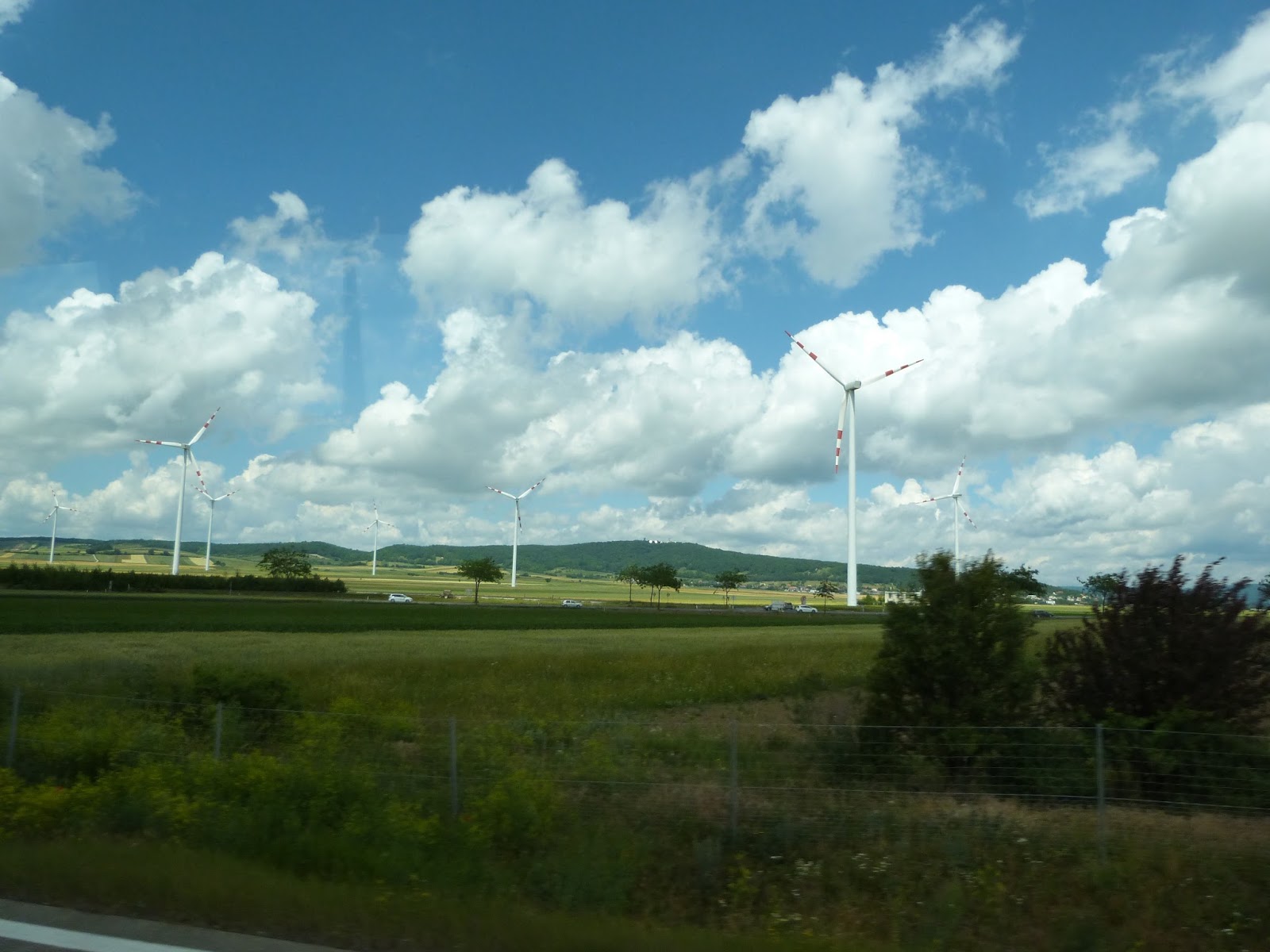
The journey was interesting partly because it showed me another side of Austria. Located along that highway, well away from the city, was some of the Austrian major manufacturing industry, including a huge petrochemical plant, all looking very well controlled and clean - no rundown equipment or rubbish lying around as far as I could tell. As well, there was Vienna’s airport and especially as we came closer to the Austrian-Slovakian border, on both sides of the highway there were large tracts of land under cultivation with wind turbines towering over them. Our guide told us there were about 2000 (!!) wind turbines on the Austrian side of the border, but there are none inside Slovakia. Instead they rely on nuclear power. However, the two countries work cooperatively in terms of their energy supply. On very windy days Slovakia purchases some of the excess electrical energy from Austria and reduces the output of its nuclear power plants. On still days Austria purchases electrical energy from Slovakia to make up the shortfall.

The other reason that it was interesting is that we learned about the history of Slovakia - including  its separation from Czechoslovakia and from the Soviet Union - and some of its social problems and policies. Our guide said no-one under 21 in Slovakia is allowed to drink, while young people in Austria can drink at the age of 16. The punishment for serving alcohol to anyone under 21 is severe - they lose their business. Overall, the biggest problems are vandalism and pickpockets - which I have heard just about everywhere I have been. We are always warned to watch our bags and to put nothing in our pockets, even when we enter churches. 

It was clear that the Slovakians despised their Soviet ‘masters’, as was demonstrated by the following very droll tale told by our guide. The people had very little access to any luxuries, and that included toilet paper. They used old newspaper instead. Finally they were able to obtain 2-ply toilet paper, which to them was a complete luxury. However, some people were saying “Do we really need this double layer?” “Oh yes” was the reply of one wit. “One copy for you, one for the government!” Needless to say, the joke spread like wildfire amongst the people.

That reminds me. Anyone ’picking’ the pocket at the back of my no doubt tempting Aboriginal-made backpack will get a wee surprise. All that is in there is some toilet paper rolled up in plastic bag, something we have been advised to carry around with us in case the local loos don't supply any. I would love to see their faces and hear their expletives when they unroll their ‘loot’. (Sorry folks - I love playing with words . . .) 

However, I digress. 

Unfortunately it was raining most of the time we were wandering around the historic old town of Bratislava, which made photography rather difficult for a start, but that did not dampen our growing interest in and admiration of the lovely buildings we saw. They have such fine attractive features, the complete opposite to the ‘boxes’ made today. It was clear that music plays a very strong part in the Slovakian culture and psyche. Apparently its university has a very fine music school. And interestingly, when I was in Vienna I saw some buskers from this city who had gone on to study operatic singing in Vienna. They had very fine voices.

When we were there there was an open market running in the centre of the old city as well, which seemed to be mainly run by Hungarians. The foods on offer included pig roasted on a spit. But guess where we had to meet at the end of our free hour?  . . . . . . outside McDonalds. What can I say?  . . . . 

On another note, this is my 8th attempt to get this one post to you. The WiFi service out here on the ocean has fluctuated considerably, with the result that the photos would start to upload then the process would freeze. I have spent hours trying to upload them on many different occasions, and as a result am as far behind again. And in a couple of days time I am on another river cruise. I hope this will not confuse you. I will do my utmost to finalise talking about my first river cruise before talking about the next one.

 
Like other cities, there is the modern town and the 'old town'. This was our first glimpse of the 'old town'.


This was apparently the oldest building left standing.

I thought this was a very attractive building, typical of the design of many buildings in the old town.


If you look closely, you can see an old cannon ball embedded in this building. It apparently was fired there during the Napoleonic wars and kept out of interest.

In case you missed seeing the cannon ball. Clearly it has been restored along with the building.


I think this was part of the town hall complex.

Another view in the same space, looking back.

There were some quirky sculptures around the old town. Apparently each had its own story.

A performance centre for the Arts.

A steam fountain in front of the performance centre. I had never seen a fountain like that before. Lots of people enjoyed walking through it.

A close-up of some of the sculptures in the beautiful facade of the performance centre.

The weather cleared after we departed from the old town. (Murphy's Law!) This is some of the country on the Austrian side of the border, with some of the wind turbines, taken from our coach.


Monday, 3 July 2017

Vienna Part 3 - a strange hotel, the Schonbrunn Palace, and the locals

Since I was going to return to Vienna on my long train journey to London, whilst the river ship was berthed in Vienna I took the opportunity to travel on a shore excursion to Bratislava in Slovakia. I will talk about that very worthwhile journey in my next post.

In this post I will complete my series on Vienna by talking about the time I spent there on my own, which was from 14 June to 17 June. 

It took quite some time to wait for my room in the intriguing hotel into which I was booked in Vienna. This hotel was right in St Stephen’s Square, but it had such a narrow frontage it took me a little while to find it. (Taxis cannot go into the square.) When I walked through the entrance door, all I could see was a narrow passage with little lighting and no signs of any kind - and most puzzling of all, no reception desk. Fortunately a gentleman arrived and saw me looking confused and told me the reception desk is on the sixth floor. (Who could have expected that?) He was heading up to the same lobby, so up we went and there was a small reception desk, a small lobby and quite a small bar lounge area. Then I was told my room would not be ready for three hours. Loathe to leave my backpack which held my computer and all my travel documents at this not particularly welcoming place, I sat there and waited, and waited.

When I was eventually shown to my room through very dark passageways, I was quite startled to find a room with a huge glass ‘cage’ in the centre. Seeing the puzzled look on my face, the porter said “That’s your shower!”. Making a mental note to remember to draw the curtains at the window before I took a shower, and at this point feeling very glad I was travelling alone, I asked “So there’s no bathroom?”, whereupon I was shown a ‘box’ in the room, which was the toilet. It had a translucent door, but at least there was some privacy. A basin between the two completed the ‘bathroom’.   

By the time I unpacked what I needed for the next couple of days, I was too exhausted to go on a long hike, so I just wandered around St Stephen’s Square and a couple of streets off the square and had an early dinner at a local cafe. I ordered one of Vienna’s famous wiener schnitzels but left most of it - it was very disappointing. I made another mental note - don’t eat there again.  (At least I had a superb one at my hotel in Salzburg a couple of days later, which more than made up for that.)

The next morning I went on an organised tour entitled ‘Historic Vienna City Tour with Schonbrunn’. This was the most poorly run and disappointing tour of my travels thus far, but I will not bore you with the details. However, the Schonbrunn Palace was an amazing place to see - absolutely over-the-top in its very ornate design and decor, but nevertheless a stunning exhibition of incredible craftsmanship and artistry. We were not permitted to take photographs in the rooms we were allowed to see, but I did buy an excellent book about the powerful Maria Theresa in the bookshop. The more I heard about this intriguing woman, the more I wanted to know. 

The next day I decided my suitcase was getting too heavy - I really needed time out to gather all the bits and pieces I had been collecting, and the small gifts I had been purchasing, and post them back home. I decided Austria would be a reliable place to do so. It took quite a long time to organise them and hike to the nearest post office, which I found out was several blocks away. It then took nearly 2 hours at the post office to go through all the rigmarole of purchasing the envelopes and boxes, which you had to do before you were allowed to fill them or write on them, then filling out all the documents and posting them. I am sure that the very patient man at the counter - the only one who could speak English - breathed a sigh of relief when I left. (He had to weigh everything, process all the documents, put two copies in little plastic bags and attach them to the parcels, add the stamps, etc., so it took him quite a while in between all the other customers - and there were lines of them because by now it was mid-Friday afternoon. And only two people were serving everyone.) 

That evening, my last night in Vienna, I went back to the Schonbrunn Palace for another wonderful concert. Surprisingly, the venue was much simpler than the other one, but the concert which featured an orchestra, a soprano and a tenor, was equally fantastic. I have so missed classical music on my journey. 

On the way back to the hotel my taxi driver proved to be quite a character - for the whole trip, he waxed lyrical on Trump. In fact, I had an equally interesting though less politically charged conversation with the taxi driver going to the concert, but we were mainly discussing how the lanes on the roads were too narrow for big coaches (my heart had been in my mouth many times), and all the problems with speeding young men in the Ferraris or on their motor bikes, which then led to discussions about all manner of other things, including all the dreadful graffiti along the banks of the main river that flows through the city (not the Danube). It is mostly in areas that are full of outdoor cafes. What a shame that such a beautiful city is despoiled like that!  

So, my time in Vienna was over, and I was sorry to leave this beautiful city. I know I should have seen so much more, even though it rained much of the time, but I needed to slow my pace. However, my next stop was Salzburg, which I loved and have written about already. 

I have nearly caught up with my posts. Yesterday I was in Estonia, and today and tomorrow I am in St Petersberg (two days of 10-hour excursions), but those stories will have to wait for a few days until I catch up with the posts about Bratislava and Budapest. 

The 'glass cage' shower, seen from the bed.

The 'glass cage' shower, seen from the other side. 

The concert venue in the Schonbrunn Palace. We were not allowed to take photos once the concert started. The lights kept changing colour.

This sculpture was in a street full of shops that led to St Stephens Square. As I recall, the sculpture was related to being saved from the plague. 

The recently restored roof of St Stephens Cathedral. 

Part of the Schonbrunn Palace.

A beautiful fountain in the grounds of the Schonbrunn Palace.    

A very appealing street near St Stephens Square. 

A closer view of the building in the centre of the previous photo. A very typical building design seen in Vienna. 


Saturday, 1 July 2017

Vienna Part 2 - a magical concert at Palais Liechenstein

It was great anticipation that the passengers of our river ship and those of our sister ship berthed in Vienna at the same time (though going in the opposite direction) dressed up for an evening concert of a lifetime - ‘Mozart meet Strauss’ - at the beautiful Palais Liechenstein in the heart of Vienna.

This venue, the palace owned by the princely family of Liechtenstein, was all lit up and just gorgeous. Such a stately building, which was surrounded by lovely gardens. In the lobby, where we were welcomed with champagne, there was an ornate regal golden carriage on display. With a couple of others, I was lucky enough to peak into a couple of rooms near the lobby, and photograph the beautiful frescoes on their ceilings. 

The hour-long concert was simply fabulous - I love the music of Mozart and Strauss, so I was in heaven. The venue was stunning, the announcer charming, the music divine and the soprano and baritone just so talented. The baritone made the best Don Giovanni I have seen - such delightfully wicked asides to the audience as he tried to seduce the 'married lady' - one of the most well-known scenes in 'Don Giovanni', Mozart’s famous opera about Don Juan. These were some of the top musicians of the country! And for the grand finale two members of the Austrian State ballet performed a waltz as the orchestra played Strauss’s famous ‘The Blue Danube’. It was unforgettable!

The last three photos were taken in the concert venue. Unfortunately I was seated in position from which it was almost impossible to take a photo of the performances, even though we were permitted to do so. I used my zoom lens to get the one decent photo I had.   


Vienna, Austria Part 1 - a city tour

Back to the river cruise . . .

Those of us on the river ship who had never seen Vienna before were really excited to go on our first tour of this famous city. And I must say it exceeded all expectations.

It is the most wonderful, inspiring city, with so many buildings that can only be described as great works of art, as well as stunningly beautiful gardens and sculptures and fountains everywhere. It is no surprise it is considered the most beautiful city in the world. So many of these buildings reflect its wonderful heritage and the devotion of its people to their cultural heritage - music, dance and art. Its parliamentary buildings were designed to celebrate democracy and its roots in ancient Greece. They were simply breathtaking! 

The only drawback of our coach tour of the city was that we drove around too quickly to take many photos and to build memories that would do it justice.

After we hopped off the coach we were whisked through the very impressive Heldenplatz, or Heroes’ Square, which was first built to honour the veterans of the Napoleonic Wars, to the Hofburg just behind it. The Hofburg is the former imperial palace of Austria, and is located right in the centre of Vienna. It was built in the 13th century and has been added to since. It once was the seat of power of the Habsburg dynasty, but now is the official residence of the President of Austria, and still the home of the Spanish Riding School. Apparently the renowned Vienna Boys Choir also performs here. 

The Spanish Riding School is where the world-famous Lipizzaner Stallions perform. This unique breed of horses was developed by the House of Habsburg, which ruled over Spain and Austria for over three hundred years. However, at the time we visited there, the stallions were at their summer riding school some distance from Vienna. Some of my fellow passengers went there the next day and saw some of these stallions in their stables. 

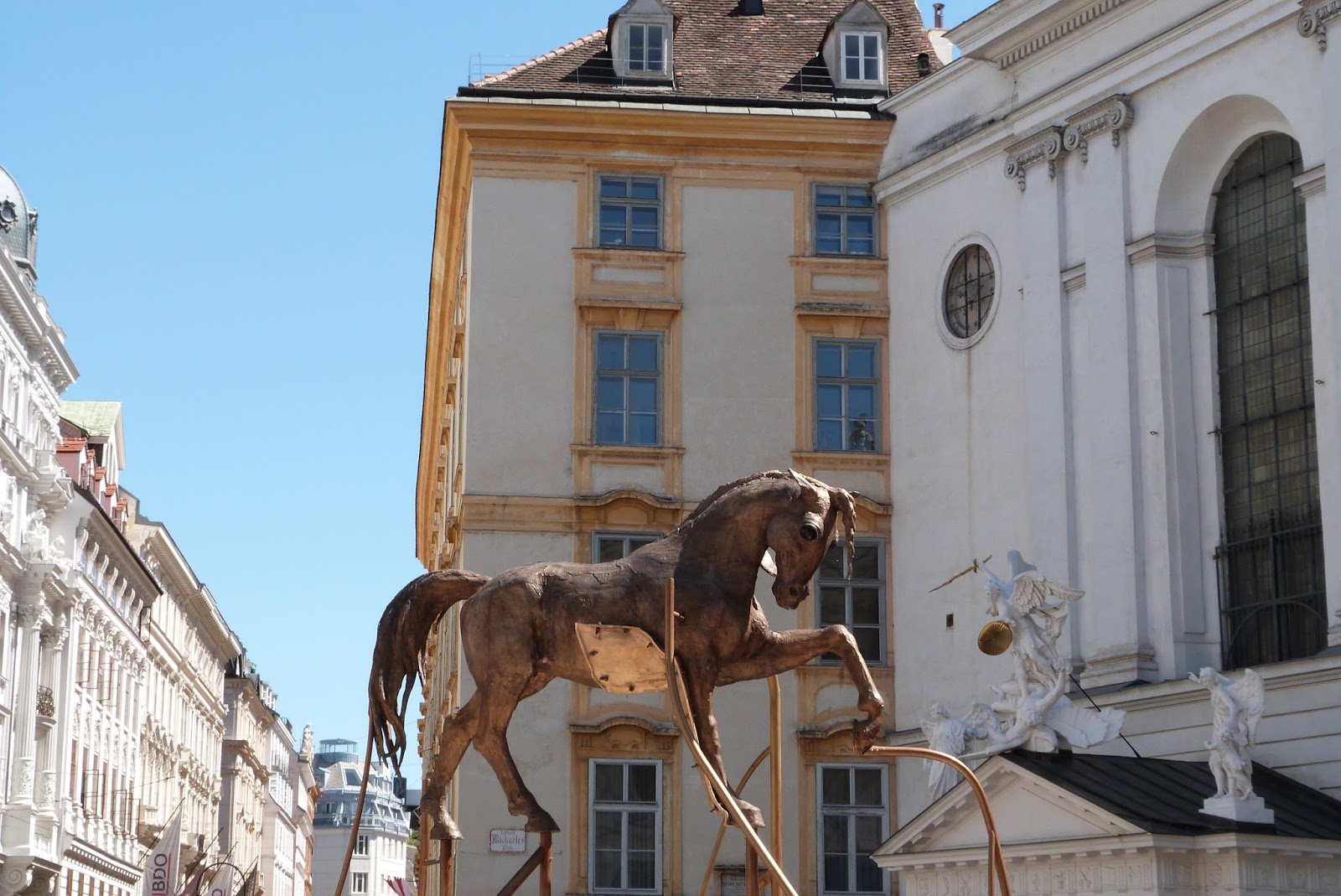
When we walked through the the big entrance to the Hofburg and out into the streets just behind it, we saw sculptures celebrating these amazing stallions. We also saw several horses and very stately carriages, with the horses and their drivers formally dressed up in the old traditional way. It would have been a memorable experience to go for a tour on one. Instead we walked through to St Stephens Square for a quick wander around, though since our ship was staying overnight in Vienna, some couples elected to continue exploring the lovely city on their own. As I was staying in Vienna again when I made my way slowly to England, I went back to the ship and from there visited some IT experts to seek help for my bothersome Apple devices at a company our tour guide kindly recommended. I have mentioned them in an earlier blog.

Note: The first seven photos were taken from the coach with some difficulty.    

A very impressive basilica next to the Danube river. The locals call it the 'Mexican' Church because of the support Mexico gave to Austria when it applied to be declared a sovereign neutral nation. 

We saw very few tall modern buildings. This one apparently lights up from within at night. 

One of the many stately buildings we saw.

One of the many beautiful parks thought the city. I gather this one has a statue dedicated to Mozart.

Yet another city view.

Vienna's tribute to the ancient Greeks and the beginning of democracy.

Vienna has trams as well as buses.

A statue commemorating the reign of Maria Theresa, probably the most well-known member of the Habsburg dynasty. This statue was located in a square opposite Heroes' Square.

One of the heroes celebrated in Heroes' Square.

Our first view of the Hofburg.

Another part of the Hofburg.

More of the Hofburg.

The archway entrance to part of the Hofburg. Some of the horses and carriages passed through here.

Inside the archway entrance.

One of the modern sculptures celebrating the Spanish Riding School.

See the horse sculpture which appears to be between the two streets but in fact is in the square in front of them. 

St Stephens Cathedral, which is undergoing restoration work.  I stayed opposite the cathedral on my return to Vienna a few days later.