Sunday, 8 April 2018

Across the Kimberley Part 5 - Bell Gorge

After our picturesque yet bumpy journey right out in the wilderness along the Gibb River Road, we finally arrived at the Bell Gorge Wilderness Lodge, which was literally right in the middle of ‘nowhere’, surrounded by native grasses and trees. 

It consisted of a central building with an outdoor but covered dining area and a huge circular area, in the centre of which was a big camp fire, as well as ‘tented cabins’. As I was a solo traveller, I had one of these cabins to myself. These had a slatted timber floor and corrugated iron ‘ensuite’ with a shower and basin and toilet, and canvas walls.

On our arrival we received the warmest of welcomes, and after being helped to our cabins to store the luggage we needed for the two days, we were greeted with some wonderful nibbles and drinks around the campfire. There were small groups of other people staying there as well, and very soon we were all chatting away and sharing stories of our journeys. And it was not long before I knew the reason for the campfire. There was an incredible drop in temperature over that hour, from about the 40 degrees Celsius we had over the day to nearly zero!  This is what happens in outback areas as the sun sets! Soon we were all availing ourselves of the thick warm ponchos that were on offer, and were very glad of them as we then ate our delicious dinner. 

That night I was so cold I went to bed fully clothed in my thickest jacket, woolly hat, socks, etc. I still shivered like mad until I eventually fell asleep. And I nearly froze having a shower in the morning. My goodness that was tough! I have never towelled myself and dressed so quickly. (This was to be the case on much of the rest of our journey!)

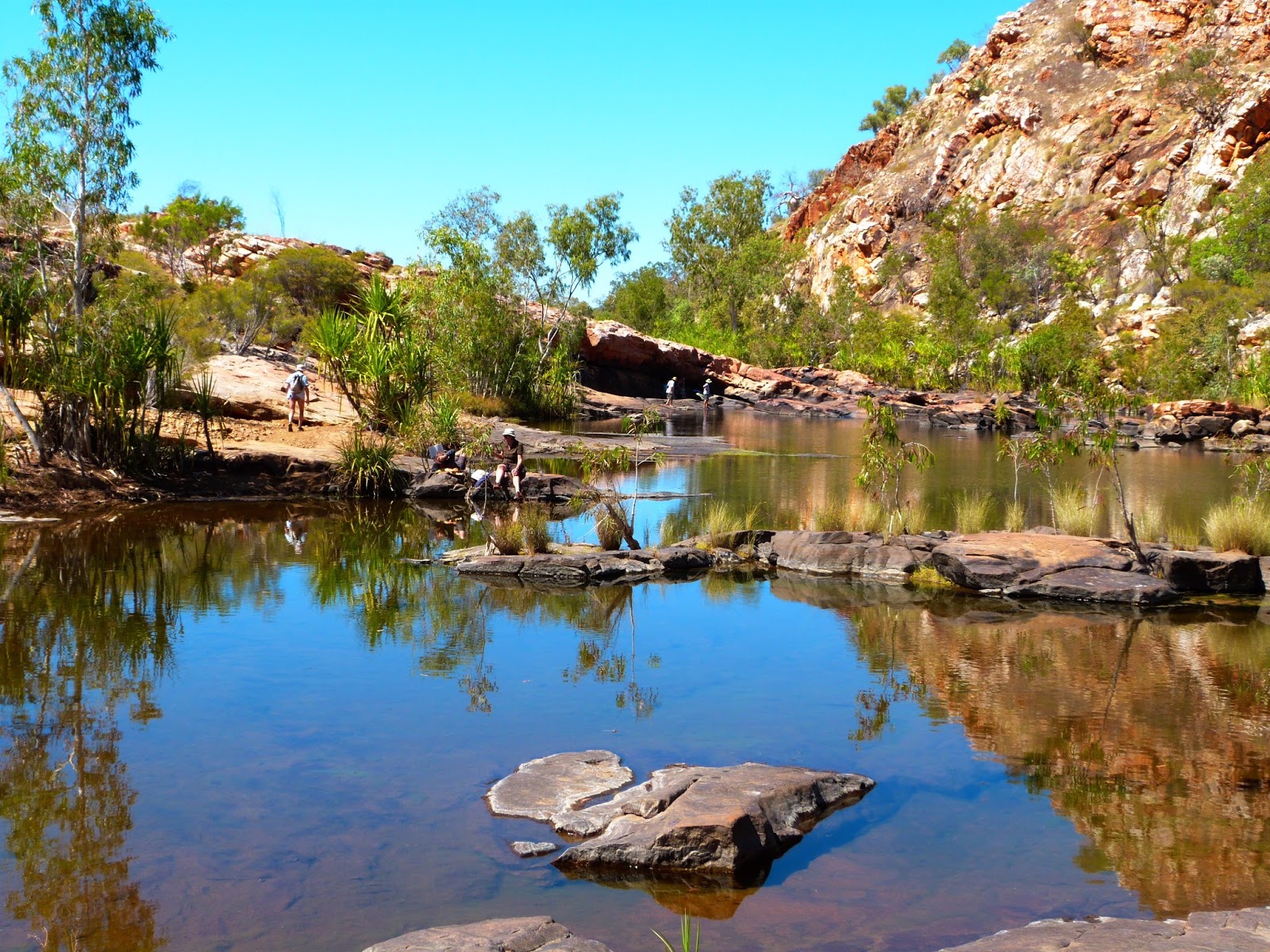
And yet a couple of hours later it was back to 40 degrees! And we were off to see the lovely tiered water-holes and rugged cliffs of Bell Gorge. some of which were a wonderful rich red colour. I am not allowed to swim because of my ears, but most of our group had a wonderful time in the water, delighted to have relief from the relentless heat. It was great for them to have a safe place to do so - there were no crocodiles here! 

However, even though I sat in as much shade as was available to enjoy my picnic lunch and watch everyone having fun, I came close to having heat stroke as I carefully picked my way over all the rocks along the track on the way back to our bus. I became quite dizzy, but Chappy again rescued me, sitting me down and placing cool wet cloths on the back of my neck until I recovered enough to go on. 

That night we had another great time around the camp fire and terrific food, so we were sorry to leave there the next morning for our next destination. 

My first photograph is the only one I was able to get of the lodge, the next one I think was a creek we stopped at on the way to Bell Gorge, and the rest of the photos were taken at Bell Gorge. 


Saturday, 7 April 2018

Across the Kimberley Part 4 - more about our Aboriginal people

After we left the colourful Windjana Gorge, we began a new phase of our journey - driving along the famous Outback highway, the Gibb River Road. This was an unmade road. Even though it had been graded since the last floods in the previous Wet Season, it was quite a bumpy ride! 

Along that road, we first visited the remains of the old homestead on the cattle station where the young Jandamarra had lived with his mother for a while. I found that very moving. 

If you saw the Opening Ceremony of the Commonwealth Games at the Gold Coast in Australia last week, you would have seen some performances by our Aboriginal and Torres Strait Islander people, including the Bangarra Dance Company. I have seen several performances of the Bangarra Dance Company. They are simply extraordinary and powerful, especially when telling the story of the early encounters between our First People and the white settlers with symbolic imagery and artistic and very talented dancing. 

Many white people both here and overseas in those early times claimed Aboriginal people were ‘no better than animals’ - even sending their skulls to museums in England to try to prove they even had smaller brains (which of course was not the case)! The arrogant, ignorant beliefs of these white men were used to excuse and justify their brutality towards the Aboriginal people - the killing, the raping of the women, and the stealing of their land. On top of that, the early settlers introduced diseases that wiped out many groups of Aboriginals. 

I am sorry to say that white people have gone on causing untold harm and heartache. Countless Aboriginal children were forcibly taken from their parents for years and years - ‘The Stolen Generations’. Different tribes were herded into settlements away from their sacred sites and land, and forbidden to celebrate their culture - their stories, their art, their dance, their music. If they tried, they were beaten. The consequence was most of their 500 or so different languages have disappeared and most of the Aboriginal people who were incinerated in this way lost so much of their spirit, their dignity, their way of life and incredible knowledge of medicines and bushcraft that had been passed down from one generation to the next over sixty thousand years. It is simply appalling! I am absolutely ashamed of all those who participated in this dreadful destruction of a people. 

Now there are big social problems due to the introduction and promotion of alcohol into many Aboriginal communities by greedy white men. This has been just as destructive as tearing them away from all they knew. Before white men came our First People never drank alcoholic drinks, so they lacked the enzymes needed to break down the alcohol and were seriously affected when they drank. Between the way they have been treated and the introduction of alcohol, little wonder many have committed suicide and many have turned to drugs and alcohol and crime. 

But that is only part of the story. Many Aboriginal people have risen above all this. We have had an Aboriginal State Governor, and many Aboriginal Members of Parliament, wise leaders, university lecturers, doctors, lawyers, authors, teachers, leading sportsmen and women, opera singers, musicians, artists, cattle station managers, and so on.  And now various state governments are recognising that our indigenous people are far better at looking after our national parks than white people, so have given them charge of a number of parks. Thank goodness! They are far better custodians of our land than most white people. 

But, in fairness, I also have to say that a lot of white people have worked tirelessly to redress the wrongs that have been perpetrated. I have tried to do my bit working alongside Aboriginal and white people to provide really worthwhile programs for school students. The students simply loved them! Through this I have met many wonderful Aboriginal people and learned so much of their story. 

In the next post I will talk about the Wilderness Lodge where we spent that night and the next, and our visit to the spectacular Bell Gorge. In the meantime, enjoy the photos of the the old homestead, as well as some of the rugged scenery and majestic escarpments along the Gibb River Road. The photos speak for the selves, so I have not included captions this time, though I will say that since the signs were erected outside the old homestead, new evidence has shown that the Aboriginal people were here at least another 20 000 years earlier than the 40 000 years stated on the sign.This makes them the oldest living race in the world.  


Sunday, 1 April 2018

Across the Kimberley Part 3 - Windjana Gorge

After we left Tunnel Creek, we went for a long drive along rough roads through rugged country with dry creek beds, boab trees, ghost gums, spindly bushes and different shaped and coloured termite mounds all adding to the rich colours and textures and general beauty of the landscape. 

We eventually arrived at Windjana Gorge, which was surrounded by tall cliffs. There we saw many crocodiles lazing in the shallow green waters of the Lennard River, right next to the sandy track along which we trudged, as well as on the opposite bank. Despite their presence, were not afraid. They seemed bent on just basking in the heat, though of course you would be very foolish to wade in the water.    

With the shimmering heat - it was would have been close to 40 degrees Celsius - walking into the gorge was demanding, but the rugged beauty of the spot, especially the contrasting colours  - the bright blue of the sky, the golden sun and sands, the reds, browns, yellows and creams of the rocks and the green of the water and the vegetation - made the effort very worthwhile.

One point of interest was a fossil we saw in the roof of a hollow in the rocks. I have included a couple of photos of it. Again, I can only say that the Kimberley region is a geologist’s dream! While I did not study geology, this fascinating, awe-inspiring region certainly makes me wish I had! 

On a practical note, we were way out in a very remote area. There was no coverage for our mobile phones - we had been able to make contact with family and friends at Fitzroy Crossing and in Broome, but here we virtually isolated. Yet thank goodness there were public toilets - right in the middle of nowhere. Mind you, they could only have septic tanks to treat the waste, and of course it was rather malodorous and the toilets were pretty primitive, but that still is infinitely preferable to the whole group spreading out and squatting behind bushes where there could be snakes and other nasties.  On the whole 16-day journey in this remote region, if I recall correctly, we only had to do that once or twice. It is times like this that men have a great advantage . . .  

And as it happened, we did not see any snakes at any stage. Many of the people I met on my 8-month odyssey last year said they would be too scared to come to Australia with all its ‘dangerous snakes, spiders, sharks and jellyfish. . .’   I think I have said before - in Australia, very few people die from snake, spider and insect bites, shark attacks, and attacks by venomous marine species (such as the blue-ringed octopus and the almost invisible tiny irukandji jellyfish), and crocodiles. In total, you might be looking at just a few victims each year, who usually died because they failed to take sensible precautions.  We have terrific medical services and hospitals have antivenin to treat people who have been bitten by our more deadly snakes and spiders.  Although I have walked along countless bush tracks, I have only seen snakes in zoos!  You would be in far more danger from bears in Canada and the US! And I have to say, we are all in far more danger from drunken or overtired drivers, and drivers who have taken illicit drugs! These irresponsible, selfish people kill hundreds every year! And not just in Australia.  


The gap that leads into the gorge.

The gorge surrounded by its sheer, tall cliffs.

The incredibly green water of the Lennard River.

And the crocodiles!


A beautiful spot - like an oasis in the middle of a desert (though in the Wet Season it can be flooded)! 

See the fossil!

The same fossil, using a different light setting on my camera.


Friday, 30 March 2018

Across the Kimberley Part 2 - Tunnel Creek

Goodness, it is 30 March already, local time - Good Friday! I wish you all a very happy Easter or celebration of the Passover!

I have been very busy helping organise a number of big events. There were two in the same week just a week ago, involving a total of about 160 guests.The first was a celebration of NowRoz, the Afghan New Year, which was held to raise funds to help train science teachers, teach some young men carpentry skills and teach widows to read and write and to sew so they could support their families and villages, and the second was a ‘mini-reunion’ of people with whom I went to secondary school, and a couple of our teachers. Both were a great success and well worth the considerable work that went on behind the scenes.

But although I am now helping organise a big chemistry teacher professional development day which will be held at the end of May, and setting up other initiatives for the Royal Australian Chemical Institute, it is time to do a bit of catching up on my blog. 

In my last post I wrote about the Fitzroy River. I have now gone back to all the notes we were given, and must clarify where the river cruise actually took place. It was along what is known as Geike Gorge, which the notes say is ‘an ancient limestone barrier reef that was carved out about 360 million years ago’. This explains the spectacular limestone formations we saw. I can only encourage any visitors to the area to take that superb cruise - but make sure you use tropical strength insect repellant. 

That night we stayed at Fitzroy River Lodge, a big hotel-motel in Fitzroy Crossing. It was a very enjoyable stay. 

The first thing we did the next day was to drive to Tunnel Creek, a 750 metre long, natural underground tunnel in the Napier Range. To get into it you had to climb down over huge boulders. I could not have done so without Chappy’s strong, steady hand, which also was always there to help me inside the tunnel in the spots where it would have been easy to trip. 
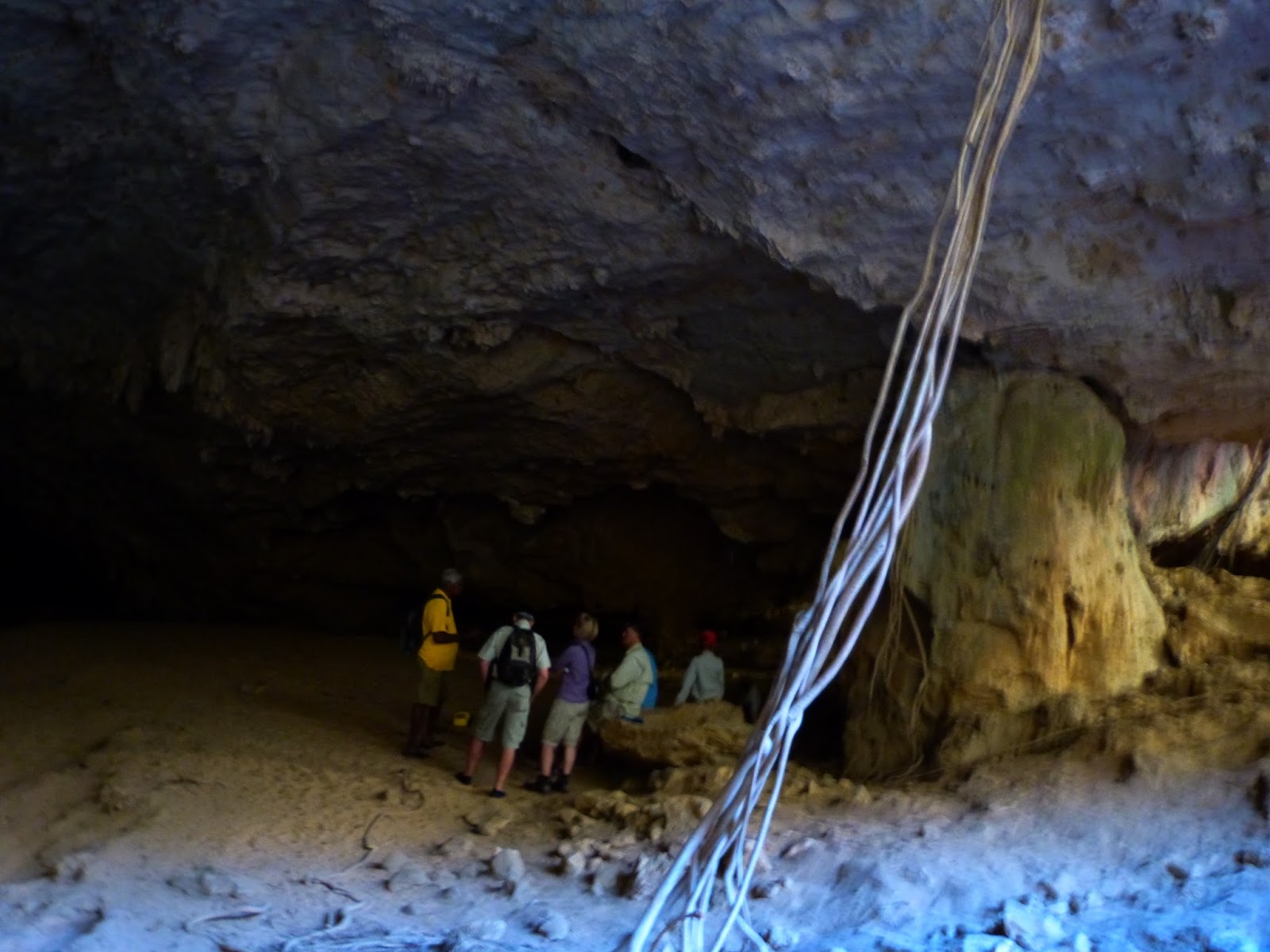
What a spectacular, unforgettable experience that was, walking in our river shoes along the creek bed through the shallow cool water, with shafts of light piercing through gaps in its ceiling and revealing the creek bed and intriguing limestone formations. The cool temperatures in there were a welcome relief from the relentless heat outside - it was around 40 degrees Celsius, the wave of hot air ‘blasting’ us whenever we left our vehicle. 

But what I most remember about Tunnel Creek, in addition to its sheer beauty, was the story of Jandamarra, an Aboriginal man who eventually became the leader of his people in fight against the English settlers who not only grabbed all their land but also butchered so many of them. What many of the early settlers did across Australia to our Aboriginal people, who we now know had been there for about 60 000 years, is simply appalling! Tunnel Creek was Jandamarra’s sacred place and was where he was tracked down and killed. Chappy shows us an ABC film of the story of Jandamarra after we left Tunnel Creek.  It is simply called ‘Jandamarra’. I now proudly possess a copy. 

The following photos show you a little of Fitzroy River Lodge, then take you on a journey to and through Tunnel Creek. Unfortunately some did not work out because it was hard to stand still, and the spaces were sometimes too large for the flash to work well. 

The view from a balcony at Fitzroy River Lodge.

Along the track to Tunnel Creek.
 Shafts of light reveal some of the limestone formations and helped us see our way; the rest of the time we used torches.


The roots of trees snaked their way though the rocky ceiling to the creek bed.


The other end of the tunnel. After a rest we had to go back through the tunnel.


The brilliant colours of minerals in the rocks were stunning.


Back into the tunnel.

There were some beautiful reflections in the water.
Some information about Jandamarra. Unfortunately that was all I could capture on my camera. The light was incredibly glary. When he was a child he was brought by his mother to live on one of the cattle stations. It was only as an adult he saw what the station owner, who had been quite kind to him and his mother, was doing to his people, along with other white settlers.


.


Thursday, 8 March 2018

Across the Kimberley Part 1 - the Fitzroy River

Early the next morning I eagerly awaited the arrival of our tour guide-driver and the small tour group with whom I would be setting off on a16-day adventure across the Kimberley, to Katherine Gorge, the famous Kakadu National Park and Arnhem Land. 

It transpired that only one couple from the Oceanic Discoverer were in this group, though fortunately we had accidentally found this out when we met on the ship and had got to know each other quite well. Unfortunately, however, I have to confess that while they were friendly and very kind to me, they were a very difficult couple to travel with because the wife constantly harangued her husband. Her nit-picking was to drive everyone mad over the next 16 days when we were all at close quarters with one another while travelling hundreds of kilometres each day in the heat in the 20-seater bus. Many eyes rolled time and again. When another passenger confronted her in the end, saying something like “For goodness sake give it a break!”, she said she thought that was how to make a marriage alive! And they were in their sixties, I would say . . .

But overall the passengers were fascinating, really friendly and pleasant adventurous people. They included a very bright and cheerful, very fit English couple and a retired Australian Diplomat. I am delighted to say some of us are still in contact with one another. 

Anyhow, we all agreed how very lucky we were to have our tour guide-driver, know to all as ‘Chappie’.  What a wonderful man he was! A real salt-of-the-earth character. He knew so much about the region and told us so many interesting tales, was an excellent driver, and looked after all of us beautifully. This was just less than a year after I had a dreadful fall in which the main damage was I fractured and partly crushed one of my vertebra, so I was rather concerned I might trip and fall. This was really, really rocky country, but whenever the tracks we walked on looked dicey, he would hold my hand and arm very firmly to ensure I did not fall. A couple to times he stopped me going along a track that would be too dangerous. This included a long trek to see the Mitchell Falls. Thanks to his care, I did not fall once! 

I would add, ours was no ordinary bus. It was basically the cabin of a bus sitting on a 4-wheel drive truck.  We had to climb quite a few steep steps to get in and out of it.  But we need a very tough vehicle, because the roads were unmade and only graded for the most part. This regions is subject to big floods in the Wet Season. Sometimes we saw flood debris as much as 20 metres high up in trees, and we often saw broken-down vehicles, with their chassis snapped by the rough roads and the dry, rocky creek beds over which we often had to drive. Talk about a bone-shaking experience! We were rotated around the bus each day so everyone shared the worst of the seats. When you sat above the back wheels in particular, even your teeth rattled uncontrollably! This is not a region for taking anything but the very toughest of 4-wheel drive vehicles. 

That first day we set off off for the Fitzroy River. Along the way we saw countless boab trees. Of these, one stood out as the most incredible, massive tree know to the locals as ‘Big Billy’.  Chappie told us an African legend about these trees. Apparently they use to preen themselves as being the most beautiful of trees, which made all the other trees very jealous and very angry. So one day, to teach them a lesson, the gods pulled them out and stuck them back in the ground upside down! And they really do look like their roots are sprouting out of the top!

At the Fitzroy River, we went for a cruise along the river and a picnic with billy tea with an Aboriginal man. The river was just beautiful in parts, and the water was the most incredible colour. The place where we landed was full of picturesque vines. I was spellbound as he sat there and explained all the family relationships between Aboriginal people and some of their other customs. They were so intricate and inclusive, I thought, not for the first time, we really need to listen more to our Aboriginal people and learn from their wisdom. A very memorable campfire all told! 

On the way back, the Aboriginal man, who was sitting right behind me in the boat, said to me to keep very still. He then swiped his hand across on my back, not so hard that it would hurt, and said  “Good. That’s gone!” Realising it had to have been some kind of insect that had landed on my back, I asked what it was. He said “You don’t want to know!” I never did find out . . . We had not experienced insects on our cruise, but here there certainly were lots of mosquitoes. Obviously this had been a much large insect than that. I am glad I did not see it. 

By the end of the day, we were all very ready for the enjoyable smorgasbord dinner we had at the local hotel-motel that night. 

Enjoy the photos! 

'Big Billy'

Up close to Big Billy

Our 4-wheel drive 'bus', with our red 'carpet'! 

Some beautiful wattle growing near Big Billy

Along the Fitzroy River.


Near our picnic spot.


Our Aboriginal guide is at the campfire boiling up the billy tea.